
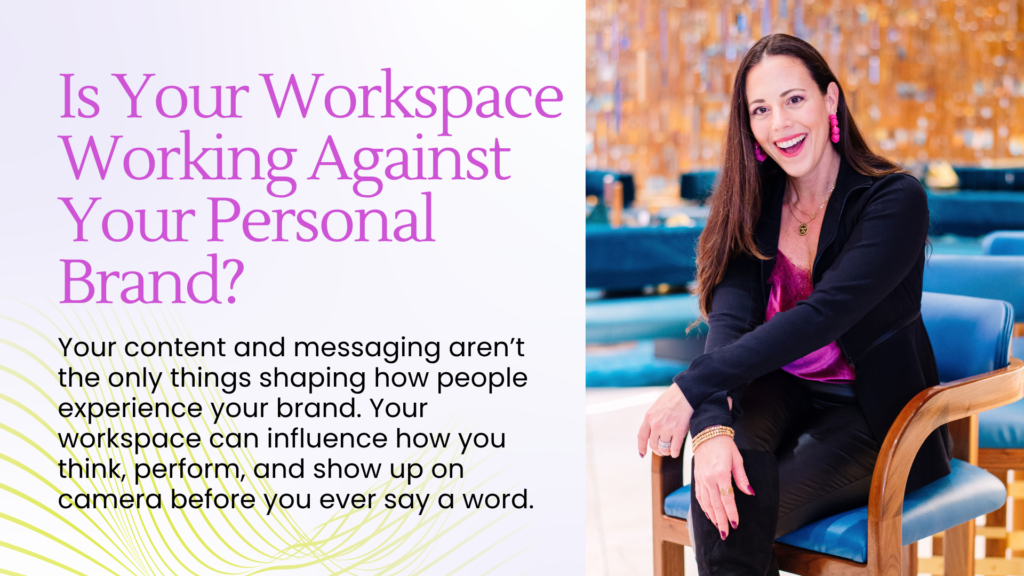
Your workspace can influence both how you perform and how other people experience your personal brand. Visual clutter, poor lighting, distracting surroundings, and an environment that no longer reflects the level of business you’re building can create friction in how you focus, make decisions, and show up online.
For entrepreneurs who work from home, the goal isn’t to create a picture-perfect office. It’s to intentionally design an environment that supports clarity, confidence, productivity, and the identity you’re growing into.
Start with three things: reduce visual clutter, improve your sensory environment through lighting and other intentional details, and introduce visual cues that reinforce where you’re going. Then consider what clients see on camera, because your Zoom background, lighting, camera placement, and surroundings are communicating something about your brand before you ever begin speaking.
The biggest takeaway?
You may be trying to build your next level while sitting in an environment that keeps reinforcing your current one.
Every single person building a personal brand online is thinking about their content.
Their messaging.
Their positioning.
Their visibility.
But almost nobody is thinking about what is literally surrounding them while they do it.
Look around your workspace for a second.
What do you see?
Boxes you still haven’t unpacked?
Papers stacked beside your computer?
Harsh overhead lighting?
A makeshift Zoom background?
A desk shoved into whatever corner of the house happened to be available?
Maybe it doesn’t seem important compared to your marketing strategy.
But what if your environment is affecting more than the aesthetics of your office?
What if it’s influencing how you think, how you feel, how confidently you show up, and even how people experience your personal brand online?
On The Secret Marketing Diary of Personal Brands, I sat down with Jayn Simpson, designer, entrepreneur, and founder of Styled to Rise, whose work sits at the intersection of environment, intentional design, identity, and performance.
And our conversation made one thing incredibly clear:
Your environment isn’t simply where you’re building the business. It can become part of how you build it.
How Does Your Workspace Affect Your Performance?
We spend a lot of time treating performance like an entirely internal problem.
Need to be more productive?
Develop better habits.
Need more confidence?
Work on your mindset.
Need to focus?
Become more disciplined.
Those things matter.
But Jayn argues that we’re overlooking another influence:
The environment we’re asking ourselves to perform inside every day.
Your brain is constantly processing information from your surroundings.
The clutter.
The lighting.
The noise.
The colors.
The unfinished projects sitting within your line of sight.
The physical organization of the room.
Even when you aren’t consciously thinking about those things, your environment is still providing sensory input.
And when you’re an entrepreneur making decisions, creating content, managing clients, leading a team, selling, and solving problems from the same space every day, that matters.
Your environment isn’t the entire answer to productivity or performance.
But it can either reduce friction or contribute to it.
Can Clutter Affect Your Focus and Productivity?
If you constantly feel distracted in your workspace, look at what your eyes are processing before immediately blaming your attention span.
A pile of paperwork isn’t simply a pile of paperwork.
It might also represent something unfinished.
The boxes in the corner may remind you of something you haven’t dealt with.
The objects covering your desk compete with the thing you’re actually trying to focus on.
Jayn recommends starting by clearing visual clutter, particularly in the workspace where you spend the most time.
And importantly, don’t try to overhaul your entire house in one weekend.
Start with one space.
Set a timer for 15 or 20 minutes.
Have a trash bag and donation bin ready.
Remove things that don’t support what you’re trying to accomplish in that environment.
The goal isn’t minimalism for the sake of having an Instagram-worthy office.
It’s reducing unnecessary visual competition for your attention.
Sometimes creating more visual clarity can help create more mental clarity too.
How Should Entrepreneurs Design a Home Office for Better Focus?
Once you’ve reduced clutter, consider what Jayn calls your sensory environment.
Lighting is a great place to start.
If possible, position yourself near natural light.
Jayn recommends working near a window when you can, particularly when you have a view of nature.
Then consider layering your lighting rather than depending entirely on harsh overhead lights.
But your sensory environment isn’t limited to what you see.
Sound matters.
Scent matters.
Color matters.
The overall feeling of the room matters.
Jayn likes incorporating elements such as flowers for living energy and pops of color without making the overall workspace visually overwhelming.
The question isn’t:
What would make this office look expensive?
It’s:
What would help me feel focused, energized, confident, and capable of doing my best work here?
That’s a very different design objective.
What Should Your Workspace Say About Who You’re Becoming?
This was one of my favorite parts of our conversation.
Jayn believes many entrepreneurs are surrounded by evidence of their current circumstances while trying to create an entirely different future.
Think about that.
You’re working toward becoming a speaker, but there’s nothing in your daily environment reinforcing that vision.
You’re writing a book, but the goal exists only inside your head.
You’re building a bigger company while working in a room that still feels temporary.
Jayn recommends introducing future-focused environmental cues into your workspace.
If becoming a speaker is one of your goals, maybe you have an image that represents yourself speaking on a stage.
If you’re writing a book, perhaps you create a mock-up of the future cover.
If you’re building toward a larger vision for the company, bring a visual representation of that goal into the environment where you work.
This isn’t about pretending you’ve accomplished something you haven’t.
It’s about intentionally surrounding yourself with reminders of what you’re working toward.
Because if you see those cues every day, your goals stop existing solely as abstract ideas somewhere in the back of your mind.
They become part of the environment you’re operating inside.
Is Your Zoom Background Part of Your Personal Brand?
Absolutely.
For many coaches, consultants, executives, and service providers, your office is no longer completely private.
Your clients see it.
Your prospects see it.
Podcast audiences see it.
Webinar attendees see it.
People on LinkedIn see it.
Every time you turn on your camera, part of your physical environment becomes part of your digital presence.
And before you’ve said a word, people have already seen:
Your lighting.
Your camera angle.
Your background.
Your surroundings.
Your level of visual organization.
The overall feeling of the space.
That doesn’t mean your office needs to look like a professionally designed television studio.
It means your background deserves the same level of intentionality you give other visible parts of your brand.
Your Zoom background is effectively part of your visual branding.
What Should a Professional Zoom Background Look Like?
Jayn recommends creating a backdrop that feels professional while still reflecting your personality.
That might mean starting with a relatively neutral foundation and then introducing intentional elements that make the space feel like you.
If you’re an author, your book might appear subtly in the background.
If you’ve received an award that reinforces your credibility, that could be displayed.
You might incorporate artwork, books, plants, or color that connects naturally with your personal style.
But balance matters.
The goal isn’t to put every accomplishment you’ve ever had on the shelf behind your head.
Your background shouldn’t compete with you for attention.
You should still be the focal point.
Lighting matters here too.
Avoid positioning yourself with a bright window directly behind you, and consider layered lighting rather than relying solely on a single overhead source.
And be cautious about relying on artificial virtual backgrounds that don’t render naturally.
If your body appears to be melting into the bookshelf behind you every time you move, the background probably isn’t helping the polished presence you intended to create.
Can Your Workspace Affect How Confidently You Show Up Online?
Think about the difference between joining an important call from a space that makes you feel scattered and walking into one that feels intentional.
Nothing about your expertise changed.
Your experience didn’t change.
Your offer didn’t change.
But you may feel different.
That’s an important part of Jayn’s philosophy.
She sees environment as connected not only to aesthetics, but also to identity.
When the environment around you feels aligned with the person you believe you’re becoming, you may begin behaving differently inside that space.
You sit differently.
You prepare differently.
You may feel more comfortable turning the camera on.
You may feel more professional when a prospective client enters the Zoom room.
It’s similar to what happens when you get dressed for work even though you’re working from home.
Does What You Wear While Working From Home Matter Too?
This came up naturally during our conversation because environment isn’t only about furniture and walls.
It’s about the experience you’re creating around yourself.
When I first left corporate and began working from home, a friend gave me advice I’ve never forgotten:
Get dressed every day as though you’re going to work.
That doesn’t mean putting on corporate attire to sit at your kitchen table.
But I’ve never been someone who can spend the entire workday in pajamas and feel like I’m fully switched on.
What we wear can affect how we feel too.
That’s how we ended up talking about my love for yellow pants.
There’s something about color that can completely change the energy of how you feel walking into the day.
Jayn made a similar point about yellow flowers and the sense of joy they can bring into a space.
Your clothes, your surroundings, your lighting, your desk, your flowers, your view outside the window…
None of these things individually make you a better entrepreneur.
But together, they help create the environment in which you’re asking yourself to perform.
What Happens When You Transform a Workspace?
Jayn shared the story of a client whose office had essentially become a storage room.
She was preparing to return to work after maternity leave while also running her own business.
But her office was still filled with boxes.
Her desk had multiple monitors, a laptop, stacks of items, and visual clutter everywhere.
So they worked together virtually over the course of a week.
They decluttered.
Donated items.
Threw things away.
Cleared the desk.
And by the third day, the workspace looked completely different.
There was a clear desk, a laptop, flowers, a candle, and intentional lighting.
But the most interesting transformation wasn’t the desk.
By day three, she was writing her first blog post in months.
She walked into the room and felt lighter.
The workspace didn’t write the blog for her.
It didn’t magically create her expertise.
It didn’t replace strategy or discipline.
It simply removed some of the environmental friction surrounding the work she was already capable of doing.
What Are the First Three Things to Change in Your Workspace?
If you’re looking around right now and realizing your workspace isn’t supporting you, you don’t need to immediately renovate your office.
Start smaller.
1. Clear the Visual Clutter
Choose the workspace where you spend the most time and remove what doesn’t need to be there.
Don’t start with your entire house.
Give yourself 15 or 20 minutes and begin with what’s directly within your line of sight.
2. Improve Your Sensory Environment
Look at your lighting first.
Can you get closer to natural light?
Can you reduce harsh overhead lighting?
Would a task lamp help?
Then consider sound, scent, flowers, color, and other details that influence how the space feels.
3. Add a Cue From Your Future
Put something in your environment that represents what you’re actively building toward.
The book.
The stage.
The bigger business.
The next version of your work.
Give yourself a visible reminder of where you’re going.
These aren’t massive renovations.
They’re intentional changes designed to make your environment more supportive of the work you’re trying to do.
Are You Building Your Next Level From an Environment That Reflects Your Old One?
Toward the end of our conversation, Jayn said something that I think every entrepreneur working from home should consider.
Many people are trying to build their next level while surrounded by evidence of their current one.
They’re trying to become more visible while working from spaces that make them feel small.
They’re trying to attract bigger opportunities while surrounded by unfinished projects.
They’re trying to become the CEO of a growing company while treating their physical workspace like an afterthought.
And again, redesigning your office isn’t going to magically double your revenue.
But that’s not really the point.
The point is to become aware of what your environment is communicating to you every day.
Does this space reinforce where I’ve been, or does it support where I’m going?
That’s a very different question from:
Does my office look nice?
And that’s ultimately what makes this conversation about more than interior design.
It’s about alignment.
Your content communicates your expertise.
Your messaging communicates your positioning.
Your visual brand communicates your identity.
And when you’re building a personal brand from home, your physical environment can become part of that ecosystem too.
So look around.
What is your workspace communicating to you?
What is it communicating when the camera turns on?
And most importantly:
Does the environment you’re building your business in look and feel like it belongs to the person you’re becoming?
Frequently Asked Questions
Can your workspace affect productivity?
Your physical environment can contribute to or reduce distractions and friction while you work. Elements such as visual clutter, lighting, noise, and organization can influence how supportive a workspace feels for focused work.
How should I set up a home office as an entrepreneur?
Start with the area where you do most of your work. Reduce unnecessary visual clutter, improve lighting, consider your sensory environment, and intentionally include elements that support both your work and the professional identity you’re building.
What makes a good Zoom background for a personal brand?
A strong Zoom background should feel professional, intentional, and aligned with your personality without distracting from you. Consider lighting, camera placement, balance, visual clutter, and subtle credibility cues such as a book or relevant award.
Should my Zoom background match my branding?
It doesn’t need to literally reproduce your brand colors or look like your website. Instead, aim for visual consistency in the overall feeling, quality, personality, and level of professionalism associated with your personal brand.
How can I improve my home office without spending a lot of money?
Start with changes that don’t require a renovation. Declutter your immediate workspace, reposition your desk for better natural light when possible, adjust lighting, remove distractions, and add a few intentional elements such as flowers, artwork, or visual reminders of your goals.
What are future-focused environmental cues?
Future-focused environmental cues are visual reminders of goals you’re actively working toward, such as a mock-up of a future book cover or an image representing a speaking goal. Jayn recommends using them to bring goals into the environment rather than keeping them solely in your head.
Does my workspace really matter for my personal brand?
For entrepreneurs who regularly appear on video calls, podcasts, webinars, or social media, the workspace can become part of how others visually experience the brand. More importantly, your environment is also where you’re creating, making decisions, and showing up to run the business, making it worth designing intentionally.
If your personal brand is growing, does the environment you’re building it from actually reflect the level you’re trying to reach?
Because visibility isn’t only about what you say online.
Your workspace, Zoom background, lighting, visual presence, and overall environment can all influence how confidently you show up and how professionally your brand is experienced.
You can have strong messaging, a great offer, and years of expertise, but if the environment surrounding your work constantly creates distraction, friction, or feels disconnected from the direction your business is growing, that misalignment can quietly affect how you operate.
The answer isn’t to create a picture-perfect office.
It’s to make sure the visibility ecosystem around your personal brand supports the authority, confidence, and opportunities you’re working toward.
That’s exactly what we uncover during a complimentary Ignite Your Brand Audit Call.
Together, we’ll map your Visibility-to-Profits™ Ecosystem to identify how your messaging, visual presence, content, and overall brand experience are working together, and where there may be gaps between the level of authority you’ve built and the way your brand is currently showing up.
You’ll walk away knowing:
✅ Where your current visual presence and brand experience may be strengthening or quietly weakening your positioning
✅ Which areas of your visibility ecosystem could be more intentionally aligned with the expert and business you’re becoming
✅ The highest-impact opportunities to create a more cohesive, professional, and confidence-building presence across the places your audience experiences foundation that supports the visibility, opportunities, and long-term growth you’re working toward
👉 Book your audit call here today and make sure the environment surrounding your visibility is supporting the next level of the personal brand you’re building.
Ginna Tassanelli and her team at HYPE Media, Inc./Stylishly Branded work with high-level experts and corporate brands that are actively seeking to become irresistible and IN-DEMAND go-to solutions to premium clients online so they can build a profitable business that makes a movement and serves with impact. They custom build and implement the Visibility-to-Profits™ Ecosystem—a four-phase system connecting strategic positioning, multi-platform visibility, lead generation infrastructure, and predictable sales processes—allowing them to be part of over $60M in client impact and still growing.