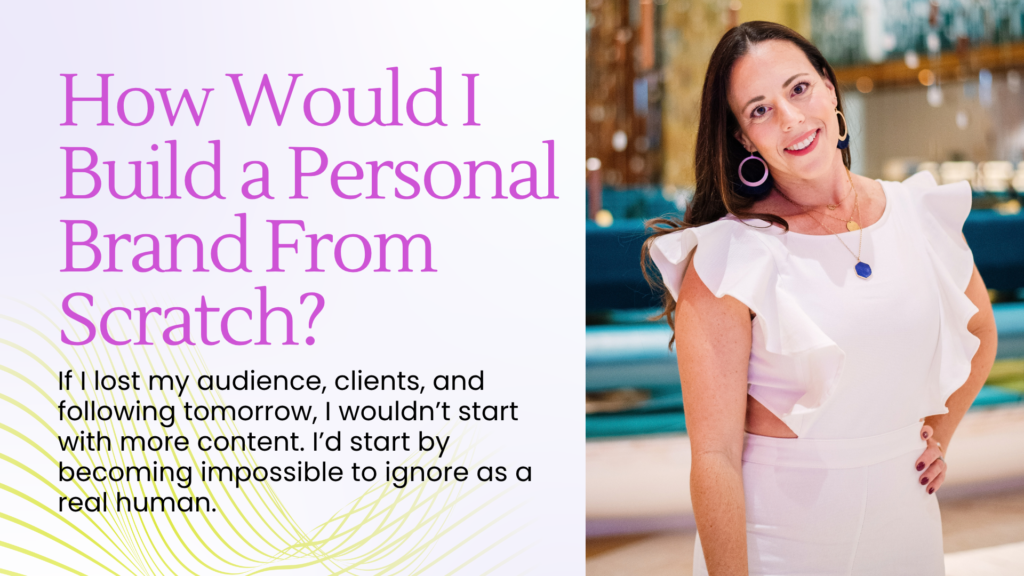
If I had to build a personal brand from scratch, I would prioritize human visibility and borrowed audiences before building an elaborate content strategy.
My first five moves would be:
- Go live once a week for 10 to 15 minutes to establish my face, voice, expertise, and point of view.
- Pitch myself as a guest on podcasts whose audiences overlap with my ideal clients.
- Pursue speaking opportunities in rooms where the right people are already gathering.
- Build strategic collaborations with complementary experts who serve similar audiences.
- Use one social media platform primarily to distribute those appearances, continue conversations, and deepen relationships rather than constantly creating new content.
The strategy underneath all five is simple: instead of waiting months or years to build an audience from zero, become more visible to audiences that already exist while giving people repeated opportunities to experience the real human behind the expertise.
The biggest takeaway?
In a market increasingly filled with AI-assisted content, your competitive advantage isn’t producing more content. It’s becoming more recognizable, trusted, and human.
If my business disappeared tomorrow, what would I do?
No audience.
No clients.
No following.
No email list.
No established online presence.
Just my experience, expertise, and the need to get people to know who I am.
I wouldn’t start by creating a 90-day content calendar.
I wouldn’t spend weeks building the perfect website.
And despite how much I love social media strategy, I wouldn’t start by trying to post my way to an audience.
I’d start with my face, my voice, and other people’s rooms.
Because the marketing environment we’re operating in has changed.
AI has made it incredibly easy to produce more.
More captions.
More emails.
More articles.
More graphics.
More videos.
More everything.
But when everyone can produce at scale, simply producing more stops being much of a competitive advantage.
What becomes valuable?
Trust. Recognition. Perspective. Connection.
And most importantly, giving people enough exposure to the actual human behind the brand that they begin remembering you.
So if I had to rebuild my personal brand from zero, here’s exactly where I’d start.
What Matters Most When Building a Personal Brand From Scratch?
Before tactics, I would build around two principles:
Front-facing visibility and borrowed audiences.
Front-facing visibility means giving people repeated opportunities to experience you directly.
Your face.
Your voice.
Your ideas.
Your stories.
Your expertise.
Your perspective.
Borrowed audiences means recognizing that when you’re starting from zero, you don’t necessarily have to wait until you’ve built a large audience of your own.
Someone else already has one.
There are podcasts your ideal clients listen to.
Organizations they belong to.
Events they attend.
Communities they trust.
Experts they follow.
Newsletters they read.
Rooms they’re already sitting in.
Instead of spending your first year shouting into an empty room, one of the smartest things you can do is get invited into rooms that are already full.
Should You Use Live Video to Build a Personal Brand?
If I were rebuilding today, live video would be my weekly anchor.
Once a week.
Same day.
Same time.
Ten to 15 minutes.
Not because I think everyone needs to become a livestream creator.
And not because you should chase whatever format an algorithm happens to favor this month.
I’d use it because it gives people a recurring opportunity to experience my expertise in real time.
I’d teach something useful.
Share an observation from my actual work.
Tell a relevant story.
Answer a question.
Challenge an assumption.
Then I’d give people a clear next step.
That’s it.
The goal wouldn’t be production quality.
The goal would be trust-building consistency.
I still remember my early experiences going live. I was nervous. My voice wasn’t perfect. I certainly didn’t look polished.
But something changed.
People could finally experience the person behind the business.
That’s difficult to replicate with another perfectly designed graphic.
Why Does Being Human Matter More as AI Content Grows?
AI isn’t inherently the problem.
I use technology. I believe in automation. Businesses should absolutely use tools that make them more efficient.
The problem happens when efficiency removes the very thing customers were trying to connect with.
You.
If AI is helping you communicate your expertise more efficiently, great.
If it’s replacing your perspective, your stories, your language, your opinions, your personality, and your actual involvement in your marketing, you risk creating something technically polished but emotionally interchangeable.
That’s especially dangerous for a personal brand.
Your personal brand is supposed to make your expertise more identifiable.
If your marketing sounds exactly like everyone else’s, you’ve lost one of the primary advantages of having a personal brand in the first place.
How Can You Grow an Audience Faster When Starting From Zero?
Borrow one.
Not literally, of course.
But strategically.
If you’re starting with 50 followers and someone else’s podcast has thousands of loyal listeners who match your ideal client profile, which opportunity gives you more leverage?
Posting 30 times hoping the algorithm introduces you to the right people?
Or having a 45-minute conversation with someone those people already trust?
This is why borrowed audiences would be central to my strategy.
You’re not trying to steal someone’s community.
You’re contributing something valuable to it.
And in return, people who may never have discovered you otherwise get introduced to your expertise.
Should You Be a Guest on Podcasts to Grow Your Personal Brand?
Absolutely.
Podcast guesting would be one of the first things I pursued.
I would identify approximately 20 to 30 shows that genuinely overlap with the audience I want to reach.
Then I would actually listen to them.
Not skim the title.
Not send the same AI-generated pitch to 100 hosts.
I’d understand the show.
I’d understand the audience.
I’d identify where my expertise could contribute something useful.
Then I’d send a specific pitch explaining why that conversation matters to their listeners.
Because here’s the mistake people make with podcast pitching:
They make the pitch about themselves.
Your accomplishments may establish credibility.
But the host’s real question is:
Will this person create a conversation my audience wants to hear?
Answer that.
If I were rebuilding, I’d initially aim for two to four podcast opportunities per month and let those appearances compound over time.
Why Are Borrowed Audiences So Powerful?
Because trust transfers.
Not automatically.
And not completely.
But an introduction matters.
Think about the difference between discovering a stranger through an advertisement and hearing someone you already respect say:
“I want you to meet this person.”
The second interaction begins from a different place.
The same thing happens when you’re invited onto a trusted podcast, introduced inside a professional community, or invited to teach on someone else’s stage.
You’re still responsible for proving your expertise.
But you aren’t necessarily starting at zero.
Borrowed audiences can shorten the distance between unknown and credible.
Is Speaking a Good Way to Build a Personal Brand?
Speaking would be my third major strategy.
And I wouldn’t wait for a TED stage.
I’d start wherever the right people are already gathering.
Chambers of commerce.
Professional organizations.
Industry associations.
Women’s business groups.
Virtual summits.
Private masterminds.
Networking communities.
Online events.
Local organizations.
Speaking gives an expert something extremely valuable:
Focused attention.
Someone scrolling social media may give you three seconds.
Someone sitting in a room specifically to learn about your subject may give you 30 minutes.
Those are very different marketing environments.
If you’re an established expert trying to build your online personal brand, you may already have enough expertise to command the room.
Your challenge isn’t becoming qualified.
It’s getting yourself onto the agenda.
Do You Need Big Speaking Engagements to Build Authority?
No.
I’d prioritize relevance over prestige.
One hundred ideal prospects in a room can be infinitely more valuable to your business than thousands of random people.
That’s especially important for consultants, coaches, professional service providers, and experts selling premium offers.
You don’t necessarily need mass awareness.
You need concentrated trust with the right people.
So if I were starting from scratch, I wouldn’t obsess over the size of the stage.
I’d ask:
Who’s sitting in the room?
How Can Strategic Collaborations Grow Your Personal Brand?
My fourth move would be finding people who already serve audiences similar to mine without directly competing with me.
Then I’d create something together.
A joint live.
A workshop.
An interview.
A webinar.
A newsletter collaboration.
An email swap.
A summit.
A small event.
The format matters less than the alignment.
You’re essentially creating an ethical audience exchange.
I introduce valuable people in my world to you.
You introduce valuable people in your world to me.
Everyone involved should benefit, including the audience.
That’s borrowed visibility at its most intentional.
Are Virtual Summits Still Useful for Building Authority?
They can be, especially when the audience and speaker lineup are aligned.
A well-run summit can bring multiple experts and their communities into one shared experience.
For someone building visibility, that can create several benefits at once:
Audience exposure.
Credibility.
Relationship building.
Email-list growth.
Long-form content.
Potential collaborations.
And future opportunities that continue after the summit ends.
The key isn’t simply appearing on every summit that will take you.
It’s choosing rooms where your expertise and ideal audience actually intersect.
Do You Need Social Media to Build a Personal Brand?
Social media would absolutely be part of my strategy.
It just wouldn’t be the foundation.
I’d use it as a distribution and conversation layer.
That’s an important distinction.
My weekly live creates content.
My podcast interviews create content.
My speaking engagements create content.
My collaborations create content.
Instead of waking up every morning asking:
What am I supposed to post today?
I’d distribute the ideas and conversations I’m already creating.
Clip the podcast.
Share a takeaway from the speaking engagement.
Turn the live into several shorter pieces.
Talk about what came up during the workshop.
Share an insight from a conversation.
Then I’d spend time actually being social.
Commenting.
Replying.
Messaging.
Following up.
Building relationships.
The platform supports the ecosystem.
It isn’t the ecosystem.
How Do You Avoid the Social Media Content Hamster Wheel?
Stop requiring every post to begin as a new idea.
That’s one of the biggest mistakes I see.
Entrepreneurs create:
A podcast strategy.
A LinkedIn strategy.
An Instagram strategy.
An email strategy.
A YouTube strategy.
A blog strategy.
Suddenly they need six different streams of ideas to feed six different machines.
No wonder marketing feels exhausting.
I’d rather create one strong idea in a format that allows me to demonstrate my expertise, then intelligently distribute that idea across the channels that matter.
One live conversation could potentially become:
A short video.
A written post.
An email.
A blog topic.
Several quotes or insights.
A follow-up conversation.
A podcast talking point.
Now you’re not creating endlessly.
You’re building intellectual property and distributing it.
What Would My Weekly Personal Brand Strategy Look Like?
If I were rebuilding from scratch, I would keep the cadence intentionally simple.
Every week: one 10-to-15-minute live video.
Throughout the week: consistent outreach for podcast, speaking, summit, and collaboration opportunities.
On social media: distribute what I’m already creating while having real conversations and building relationships.
Then each month, I’d aim for:
One to two podcast guest appearances going live.
At least one speaking engagement or strategic collaboration.
At least one substantial piece of long-form content that can continue being discovered after publication.
The exact numbers can change based on your capacity.
The principle shouldn’t.
Create opportunities to be experienced, not just consumed.
Should You Use AI to Build Your Personal Brand?
Yes, but don’t let it become the brand.
Use AI to brainstorm.
Research.
Organize ideas.
Repurpose.
Improve workflows.
Analyze.
Accelerate production.
Help your team.
Reduce repetitive work.
But your perspective still needs to enter the process.
If someone could remove your name from a piece of content, replace it with another expert’s name, and nothing about the message would feel different, you have a positioning problem.
AI should make your expertise easier to distribute.
It shouldn’t make your expertise harder to recognize.
What Is the Biggest Personal Branding Advantage?
Being recognizable as a human with a point of view.
Not merely having a face in your profile photo.
Being someone people can:
See.
Hear.
Understand.
Remember.
Trust.
And eventually recommend.
As more marketing becomes easier to automate, I believe businesses need to become even more intentional about where genuine human interaction belongs in the customer journey.
The brands that stand out won’t necessarily be the ones rejecting technology.
They may be the ones using technology intelligently without automating the humanity out of the brand.
What Should Established Experts Do Differently?
If you’re already established offline, you’re not actually starting from zero.
This is important.
You may have a tiny online following.
But perhaps you have:
20 years of expertise.
Hundreds of client results.
Industry relationships.
Speaking experience.
A strong professional network.
Intellectual property.
Stories.
Case studies.
A distinct point of view.
That’s not zero.
Your job isn’t necessarily to spend years becoming credible online.
Your job is to make the credibility you’ve already earned visible and transferable.
That means getting your expertise into more rooms.
Stop Trying to Build the Audience Before You Enter the Room
This is probably the biggest shift I’d make if I had to start over.
We assume the sequence is:
Build audience.
Become credible.
Get invited.
I’d challenge that.
Get in the room.
Deliver something valuable.
Build credibility.
Let the audience grow because people experienced your value.
Then do it again.
And again.
And again.
You don’t have to wait until 50,000 people follow you before you’re allowed to speak.
You don’t need a giant email list before you can collaborate.
You don’t need a viral personal brand before someone will interview you.
Your expertise is the entry point.
Your visibility helps more people discover it.
Frequently Asked Questions
How do I start a personal brand with no followers?
Start by clearly defining your expertise, audience, and point of view, then prioritize opportunities that put you directly in front of relevant people. Podcast guesting, speaking, collaborations, live video, and professional communities can help you build visibility without relying solely on growing your own social following first.
What is a borrowed audience strategy?
A borrowed audience strategy involves contributing value to an audience someone else has already built. Examples include appearing on podcasts, speaking at events, joining summits, collaborating with complementary experts, or contributing to established communities.
How often should I go live when building a personal brand?
If live video fits your audience and strengths, a manageable starting cadence could be once per week for approximately 10 to 15 minutes. Consistency and relevance matter more than producing long broadcasts. This is the cadence I would personally use if rebuilding from scratch.
How many podcasts should I pitch?
In the episode, I recommended identifying roughly 20 to 30 relevant podcasts and making consistent, personalized outreach, with an initial goal of landing recurring guest opportunities rather than sending mass generic pitches.
Is podcast guesting good for SEO?
Podcast appearances can create additional searchable assets around your name and expertise, particularly when episodes have public web pages, transcripts, show notes, or other indexable content. The SEO value varies depending on the show and how the episode is published.
Should social media be the foundation of a personal brand?
Not necessarily. Social media can be extremely useful for distributing ideas, staying visible, and continuing conversations. But your broader visibility ecosystem can also include speaking, podcasting, partnerships, email, search, events, media, and other channels.
Will AI make personal branding less important?
AI makes content production easier, which can increase the importance of differentiation, recognizable expertise, trust, and a distinct point of view. The opportunity isn’t necessarily to avoid AI, but to use it without allowing your marketing to become interchangeable.
You may already have enough expertise to become known. The problem is that too few of the right people are experiencing it.
If your marketing depends almost entirely on posting to the audience you’ve already built, you’re limiting your visibility to the size of your own room.
Your next growth opportunity may be getting your expertise onto the right podcasts, stages, collaborations, conversations, and platforms, then building a system that turns those moments of visibility into lasting authority and opportunities.
That’s exactly what we uncover during a complimentary Ignite Your Brand Audit Call.
Together, we’ll map your Visibility-to-Profits™ Ecosystem to identify where your expertise is already strong, where your visibility is too dependent on your own audience, and how your positioning and marketing can create more opportunities for the right people to discover and trust you.
You’ll walk away knowing:
✅ Where your current visibility strategy may be keeping your expertise inside too small of a circle
✅ Which authority-building channels could put you in front of more of the right people without requiring endless new content
✅ The highest-impact opportunities to connect your visibility, positioning, relationships, and customer journey to revenue
👉 Book your audit call here and build a visibility strategy that gets your expertise into the rooms where your next clients are already paying attention.
Ginna Tassanelli and her team at HYPE Media, Inc./Stylishly Branded work with high-level experts and corporate brands that are actively seeking to become irresistible and IN-DEMAND go-to solutions to premium clients online so they can build a profitable business that makes a movement and serves with impact. They custom build and implement the Visibility-to-Profits™ Ecosystem—a four-phase system connecting strategic positioning, multi-platform visibility, lead generation infrastructure, and predictable sales processes—allowing them to be part of over $60M in client impact and still growing.