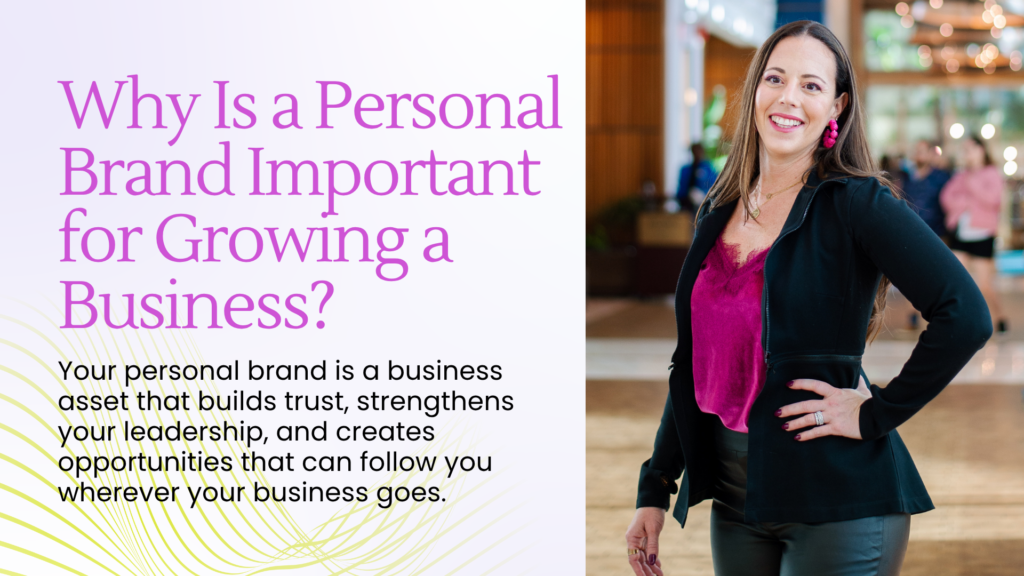
A personal brand is important for growing a business because people increasingly choose to buy from, work with, and follow leaders they know, like, and trust. A strong personal brand gives your expertise, reputation, relationships, and leadership an identity that belongs to you—not a company, platform, offer, or business model.
If the company disappeared tomorrow, what would people still know about you?
It’s a question more entrepreneurs should be asking.
Because your business may change.
Your offers may evolve.
You might introduce a new service, move into a different industry, change companies, launch another venture, or completely reinvent what you do five years from now.
But there’s one business asset capable of moving through every one of those transitions with you:
Your personal brand.
And that’s why building one isn’t simply about becoming more visible online.
It’s about creating something you actually own.
What Makes Your Personal Brand a Business Asset?
When I sat down with leadership systems expert and strategic advisor Joan Robison, we talked about something I believe far more entrepreneurs need to understand.
Your personal brand isn’t simply there to help you sell more.
It’s an asset.
Joan has spent more than 25 years building businesses, developing leaders, and helping organizations grow. During that time, she’s moved through different businesses, opportunities, programs, and seasons.
What stayed consistent?
Her.
Her expertise.
Her reputation.
Her relationships.
Her ability to lead.
That’s the power of a personal brand.
When your entire reputation is attached to someone else’s company, platform, or product, you’re building on something you don’t completely control.
When people know you, the relationship stays with you.
That’s particularly important for coaches, consultants, service providers, network marketers, and anyone building a people-driven business.
Your business is something you’re building.
Your personal brand is something you’re taking with you.
Why Do People Follow Leaders Instead of Companies?
People have more choices than ever.
More coaches.
More consultants.
More service providers.
More products.
More businesses promising similar outcomes.
So when expertise starts looking interchangeable, what becomes the differentiator?
Leadership.
People want to know who they’re trusting.
They want to understand what you believe.
They want to see how you think.
They want to know how you communicate.
And they want to feel some level of connection before deciding to work with you.
That’s why your credentials alone aren’t enough.
You can tell someone you’re experienced.
Your content can demonstrate it.
But your personal brand gives people the opportunity to experience your leadership before they ever become a client, customer, or team member.
That’s an entirely different level of trust.
How Does Personal Branding Build Trust?
There’s an old marketing principle that people buy from people they know, like, and trust.
The platforms have changed.
The tools have changed.
Marketing has changed.
That principle hasn’t.
But here’s where entrepreneurs sometimes get personal branding wrong.
They assume “know, like, and trust” means posting more.
It doesn’t.
You can publish content seven days a week and still feel completely disconnected from your audience.
Because familiarity isn’t the same as relationship.
Someone knowing your name isn’t the same as knowing you.
Real trust is strengthened through interaction.
Responding to people.
Starting conversations.
Sending the voice note.
Getting on the call.
Asking the question.
Remembering something someone told you.
Showing genuine interest without immediately trying to turn the interaction into a transaction.
Joan said something during our conversation that perfectly captures this:
Everything good comes from conversations.
That’s why your personal brand can’t exist only in your content.
Your content introduces your leadership.
Your relationships reinforce it.
Why Isn’t Visibility Alone Enough to Grow a Personal Brand?
This is where a lot of entrepreneurs get stuck.
They’ve been told they need to “build their brand,” so suddenly they’re trying to do everything.
LinkedIn.
Facebook.
Instagram.
YouTube.
TikTok.
Email.
Podcasting.
Lead magnets.
Ads.
Video.
And eventually, they’re so busy maintaining their visibility that they don’t have time for the activities that actually move the business forward.
That’s not strategic visibility.
That’s distraction disguised as marketing.
Joan made an important point during our conversation:
You can work incredibly hard on things that don’t move the needle.
A beautiful Canva graphic isn’t automatically going to create a client.
Being active on five platforms doesn’t automatically create demand.
Having the most sophisticated funnel doesn’t matter if you’re not having conversations.
Your personal brand doesn’t become valuable because you’re everywhere.
It becomes valuable because the right people consistently understand who you are, what you know, what you stand for, and why they should trust you.
That’s a much different goal.
Do You Need to Be Everywhere to Build a Strong Personal Brand?
No.
In fact, trying to be everywhere can slow you down.
One of the most valuable lessons Joan shared from building her own brand was the importance of layering instead of trying to build everything at once.
Start with what you already have.
Build relationships with the people already in your network.
Use the platforms where your audience actually spends time.
Develop one piece of the system.
Then add the next.
You don’t need to spend $20,000, $30,000, or $40,000 creating an elaborate marketing ecosystem before you’ve established the fundamentals.
And you don’t need to manufacture a massive online presence before you can become known.
Depth can be more valuable than breadth.
I’d rather see you build meaningful recognition among the right 1,000 people than remain forgettable to 100,000.
How Can Systems Strengthen Human Connection?
There’s another misconception I want to challenge.
Systems don’t have to make your business less personal.
The right systems should give you more time to be personal.
Joan described building systems specifically so she could talk to more people.
That’s the point.
Automation should remove repetitive work.
Processes should eliminate unnecessary decisions.
Content systems should reduce the amount of time you spend staring at a blank screen.
Your CRM should help you remember who needs follow-up.
Your marketing ecosystem should create opportunities for conversations.
Then you show up for the part technology can’t replicate.
The relationship.
This distinction is becoming even more important as AI makes it easier to produce more content, faster.
More content isn’t necessarily going to differentiate your brand.
More humanity will.
What Should You Focus on When Building Your Personal Brand?
Start by simplifying.
Instead of asking:
“How can I become more visible?”
Ask:
“What do I want people to know me for?”
Then:
“Am I consistently demonstrating that through the way I show up, communicate, and lead?”
And finally:
“Am I building actual relationships with the people I’m trying to reach?”
Because a personal brand isn’t something you manufacture.
It’s the reputation you’re intentionally reinforcing.
Your content contributes to it.
Your conversations contribute to it.
Your client experience contributes to it.
Your leadership contributes to it.
And every interaction teaches people something about what it would be like to work with you.
Your Business May Change. Your Reputation Goes With You.
This may be the most important reason to invest in your personal brand.
Businesses evolve.
Careers change.
Industries shift.
Platforms disappear.
Offers stop making sense.
Opportunities emerge that you couldn’t have predicted five years earlier.
When you’ve built your reputation around you, you don’t have to rebuild your credibility from zero every time your business evolves.
People already know you.
They already understand your expertise.
They already trust your perspective.
You have an audience, relationships, and reputation capable of moving with you into whatever comes next.
That’s why your personal brand isn’t another marketing project.
It’s one of the most valuable long-term assets you can build.
So don’t just ask whether enough people are seeing your content.
Ask something bigger:
If everything about my business changed tomorrow, would people still know why they should follow me?
If the answer isn’t clear yet, that’s where the real brand work begins.
Frequently Asked Questions
Why is a personal brand important for entrepreneurs?
A personal brand helps entrepreneurs build recognition and trust around their own expertise rather than relying entirely on a company, product, or platform. That reputation can remain valuable as the business evolves.
How does a personal brand help grow a business?
A strong personal brand helps people understand who you are, what you know, and how you lead. That familiarity and trust can support client acquisition, recruiting, referrals, partnerships, and other business opportunities.
Do I need a large social media following to build a personal brand?
No. A strong personal brand is about meaningful recognition among the right people, not simply accumulating followers. Consistency, clear positioning, genuine connection, and leadership matter more than being everywhere.
What’s the difference between a business brand and a personal brand?
A business brand is built around the company, while a personal brand is built around the individual’s reputation, expertise, relationships, perspective, and leadership. Your business can change while your personal brand continues with you.
How do I start building my personal brand?
Start by getting clear about what you want to be known for, choose the platforms where your audience is already active, consistently share your expertise, and prioritize genuine conversations. Build one layer at a time instead of trying to create an entire marketing ecosystem at once.
If your business changed tomorrow, would your audience still know why they should follow you?
Because your personal brand is bigger than your current offer, company, or business model.
It’s the reputation you build around your expertise, your leadership, your perspective, and the way people experience you.
And when that brand is positioned strategically, you don’t have to start from zero every time your business evolves. Your trust, authority, relationships, and visibility move with you.
That’s exactly what we uncover during a complimentary Ignite Your Brand Audit Call.
Together, we’ll map your Visibility-to-Profits™ Ecosystem to identify how clearly your personal brand communicates what you want to be known for, where your expertise is getting lost in the noise, and how to create a stronger path from visibility to trust to client opportunities.
You’ll walk away knowing:
✅ Where your personal brand positioning needs more clarity so the right people immediately understand your value
✅ How to turn your expertise and perspective into consistent visibility that strengthens your authority
✅ What to systemize so you can build stronger relationships and stay visible without trying to be everywhere at once
👉 Book your audit call here today and start building a personal brand that grows with you, not one you have to rebuild every time your business does.
Ginna Tassanelli and her team at HYPE Media, Inc./Stylishly Branded work with high-level experts and corporate brands that are actively seeking to become irresistible and IN-DEMAND go-to solutions to premium clients online so they can build a profitable business that makes a movement and serves with impact. They custom build and implement the Visibility-to-Profits™ Ecosystem—a four-phase system connecting strategic positioning, multi-platform visibility, lead generation infrastructure, and predictable sales processes—allowing them to be part of over $60M in client impact and still growing.